-

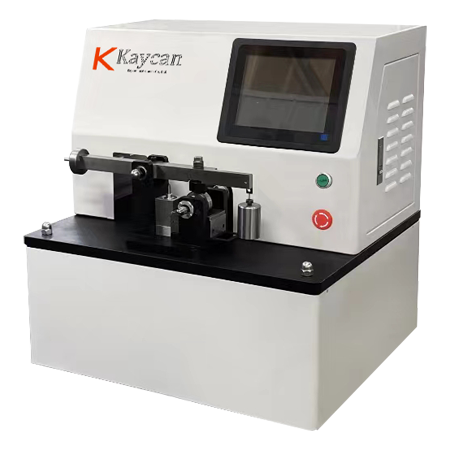
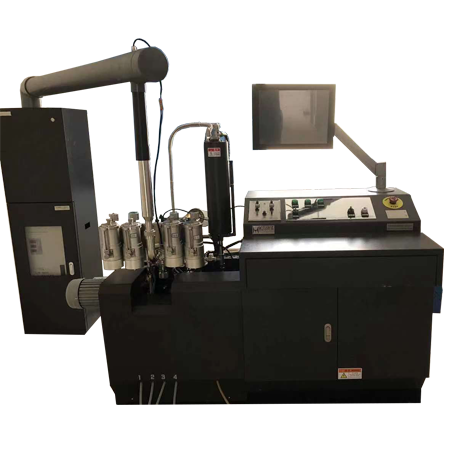
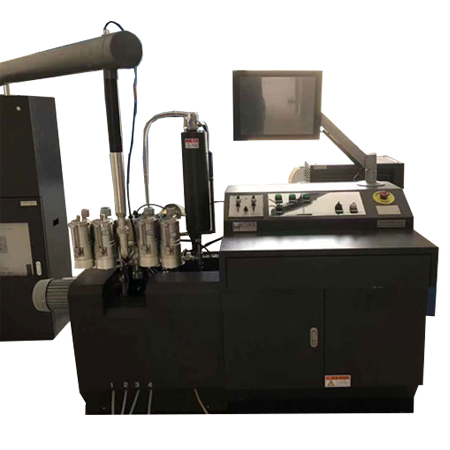
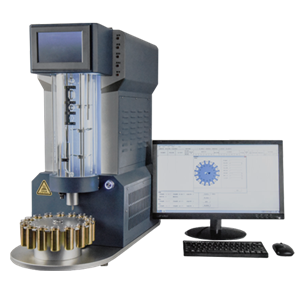
ASTM D5001 Ball-on-Cylinder Lubricity Evaluator (BOCLE)
KN-5001 Ball-on-Cylinder Lubricity Evaluator (BOCLE) conforms to ASTM D5001 Standard Test Method for Measurement of Lubricity of Aviation Turbine Fuels by the Ball-on-Cylinder Lubricity Evaluator (BOCLE) and ASTM D6078 Standard Test Method for Evaluating Lubricity of Diesel Fuels by the Scuffing Load Ball-on-Cylinder Lubricity Evaluator (SLBOCLE).. The fluid under test is placed in a test reservoir in which atmospheric air is maintained at 10% relative humidity. A non-rotating steel ball is held in a vertically mounted chuck and forced against the outside diameter of an axially mounted cylindrical steel ring with an applied load. The test ring is rotated at a fixed speed while being partially immersed in the fluid reservoir. This maintains the ring in a wet condition and continuously transports the test fluid to the ball/ring interface. The wear scar generated on the test ball is a measure of the lubricating property of the fluid.
Send Email Details -
Hot
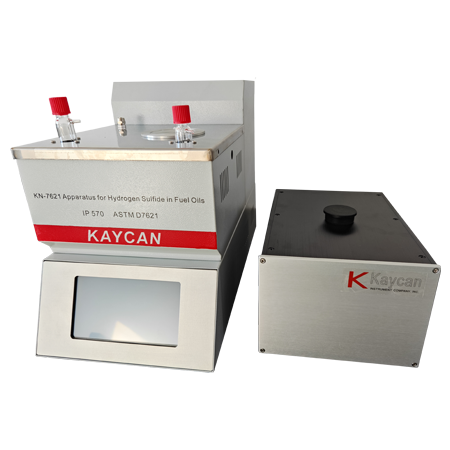
ASTM D7621 Apparatus for Hydrogen Sulfide in Fuel Oils
KN-7621 Apparatus for Hydrogen Sulfide in Fuel Oils conforms to ASTM D7621 Standard Test Method for Determination of Hydrogen Sulfide in Fuel Oils by Rapid Liquid Phase Extraction. A weighed test specimen is introduced into a heated test vessel containing a diluent base oil. Air is bubbled through the oil to extract the H2S gas. The air with the extracted H2S is passed, via a vapor phase processor (Procedure A only), to an H2S specific electro-chemical detector enabling the H2S content of the air to be measured and the amount in the liquid phase to be calculated in mg/kg/ The filter cartridge is not required for procedure B.
Send Email Details -
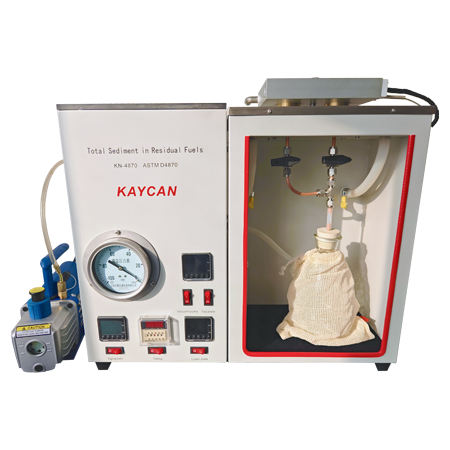
ASTM D4870 Total Sediment In Residual Fuels
Appreciable amounts of sediment in a residual fuel oil can cause fouling of facilities for handling, and give problems in burner mechanisms. Sediment can accumulate in storage tanks, on filter screens, or on burner parts, resulting in obstruction of the flow of oil from the tank to the burner
Send Email Details -
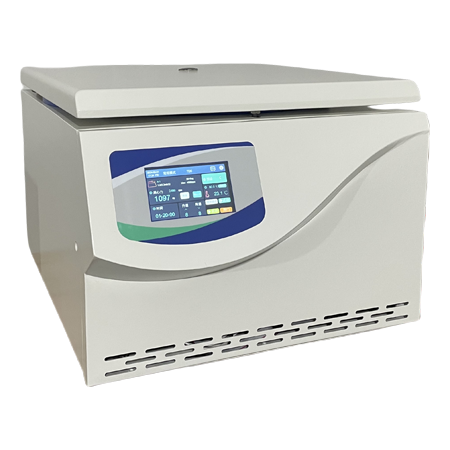
ASTM D1796 Water And Sediment In Fuel Oils By The Centrifuge Method
The water and sediment content of fuel oil is significant because it can cause corrosion of equipment and problems in processing. A determination of water and sediment content is required to measure accurately net volumes of actual fuel oil in sales, taxation, exchanges, and custody transfers.
Send Email Details -
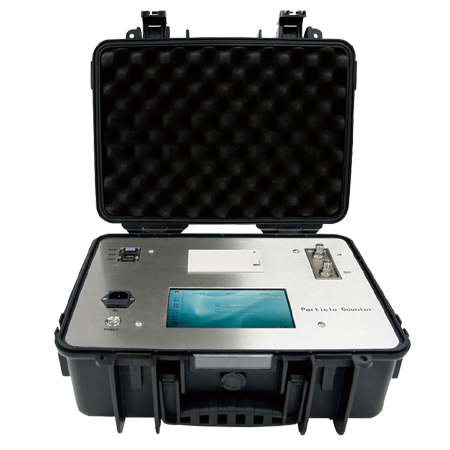
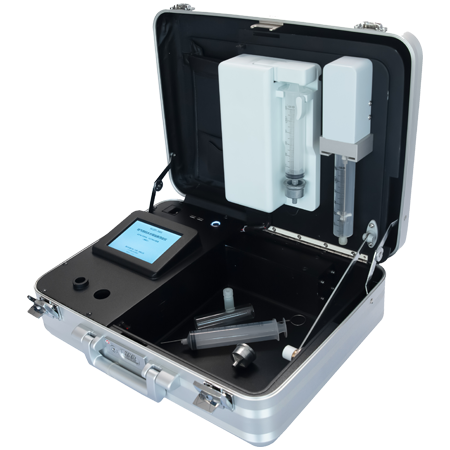
ISO4406 Portable Liquid Particle Counter
Portable Liquid Particle Counter is not only suitable for on-site testing, but also can be used as a laboratory analysis instrument. The instrument uses the light extinguishing principle to measure the size and count of fine particulate contaminants in liquid media. KN-4406B uses high-pressure and low-pressure interface, and precision syringe pump, strictly control the sampling volume accuracy. It can conduct off-line or on-line testing of oil of low viscosity or high viscosity
Send Email Details -
ASTM D2699, ASTM D2700 Apparatus for Octane and Cetane Number of Spark-Ignition Engine Fuel
KN-300R Apparatus for Octane and Cetane Number of Spark-Ignition Engine Fuel conforms to ASTM D2699 Standard Test Method for Research Octane Number of Spark-Ignition Engine Fuel and ASTM D2700 Standard Test Method for Motor Octane Number of Spark-Ignition Engine Fuel. It covers the quantitative determination of the knock rating of liquid spark-ignition engine fuel in terms of Research O.N., including fuels that contain up to 25% v/v of ethanol and the quantitative determination of the knock rating of liquid spark
Send Email Details -
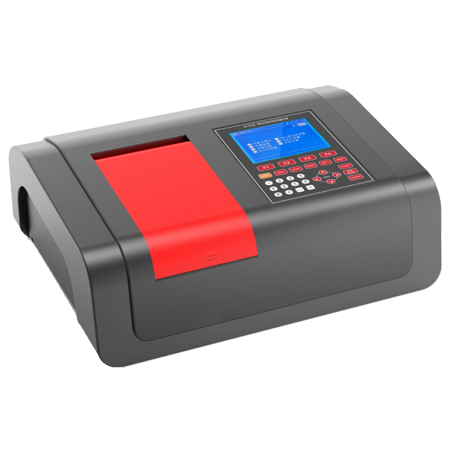
ASTM D1840 Naphthalene Hydrocarbons in Aviation Turbine Fuels
KN-UV-VIS Spectrometer conforms to ASTM D1840 Standard Test Method for Naphthalene Hydrocarbons in Aviation Turbine Fuels by Ultraviolet Spectrophotometry. This test method for naphthalene hydrocarbons is one of a group of tests used to assess the combustion characteristics of aviation turbine fuels of the kerosene boiling range. The naphthalene hydrocarbon content is determined because naphthalenes, when burned, tend to have relatively larger contribution to a sooty flame, smoke, and thermal radiation than single ring aromatics.
Send Email Details -
ASTM D2699 Octane And Cetane Test
Research O.N. correlates with commercial automotive spark-ignition engine antiknock performance under mild conditions of operation. Research O.N. is used by engine manufacturers, petroleum refiners and marketers, and in commerce as a primary specification measurement related to the matching of fuels and engines. Empirical correlations that permit calculation of automotive antiknock performance are based on the general equation:
Send Email Details -
ASTM D5452 Particulate Contamination in Aviation Fuels by Laboratory Filtration
KN-5452 Apparatus for Particulate Contamination in Aviation Fuels conforms to ASTM D5452 Standard Test Method for Particulate Contamination in Aviation Fuels by Laboratory Filtration. This test method provides a gravimetric measurement of the particulate matter present in a sample of aviation turbine fuels delivered to a laboratory for evaluation. The objective is to minimize these contaminants to avoid filter plugging and other operational problems. Although tolerable levels of particulate contaminants have not yet been established for all points in fuel distribution systems, the total contaminant measurement is normally of most interest.
Send Email Details -
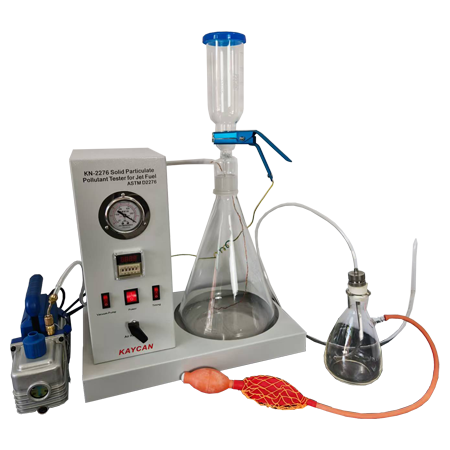
ASTM D2276 Particulate Contaminant In Aviation Fuel By Line Sampling
This tester provides a gravimetric measurement of the particulate matter present in a sample of aviation turbine fuel by line sampling. The objective is to minimize these contaminants to avoid filter plugging and other operational problems. Although tolerable levels of particulate contaminants have not yet been established for all points in fuel distribution systems, the total contaminant measurement is normally of most interest
Send Email Details -
Hot
ASTM D3948 Water Separation Characteristics Of Aviation Turbine Fuels
This tester provides a measure of the presence of surfactants in aviation turbine fuels. it can detect carryover traces of refinery treating residues in fuel as produced. They can also detect surface active substances added to or picked up by the fuel during handling from point of production to point of use. Certain additives can also have an adverse effect on the rating. Some of these substances affect the ability of filter separators to separate free water from the fuel.
Send Email Details -
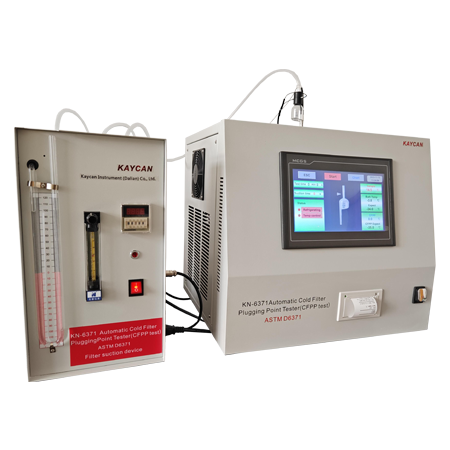
ASTM D6371 Automatic Cold Filter Plugging Point Tester(CFPP)
The CFPP of a fuel is suitable for estimating the lowest temperature at which a fuel will give trouble-free flow in certain fuel systems
Send Email Details